Seed Dispersal as a Natural Solution to Plant Competition and Ecosystem Sustainability
Allison Calle
The City College of New York
Abstract:
Seed dispersal provides the ability for plants to successfully spread their offspring in new environments far from homes. This process can help with deforestation and support the growth of plants in areas where natural regeneration is needed. Samara seeds have adapted wing-like forms to travel through wind in a mechanism called wind-dispersal. This adaptation demonstrates a trade off between morphology such as weight or surface area vs distance traveled (flight time). Our objective is to study the tradeoffs of surface area vs flight time by testing the behavior of 15 different samara seeds from Norway maple trees (Acer platanoides). We believe that the greater the surface area the greater the flight time which was soon proven not completely true but that weight was a significant factor. Our data demonstrated that the lighter the samara seeds in weight the greater the flight times while the greater the surface area the lower the flight time.
Introduction:
Plants have a unique way to spread their offspring through their environment. Seed dispersal is an amazing mechanism used by plants to establish offspring in new environments. This mechanism is extremely important for offspring to be successful. Fruits are an example of mutualistic coevolution for seed dispersal. Plants will make tasty fruit for animals to eat so that their offspring (seeds) can be dispersed away from the parent through digestion. Coconut seeds are dispersed through water; by floating through seas this allows them to have the ability to spread their offspring far in distance. If an offspring is planted right next to its parent; that creates too much competition and in some cases the seed will never grow. Dispersals allow seeds to travel far in distance from their parents where they can successfully flourish by using components such as water, wind or even animals. Using all these techniques, having planted Samaras can really help the environment completely. Having these plants around when deforestation happens can help the first resort itself faster.
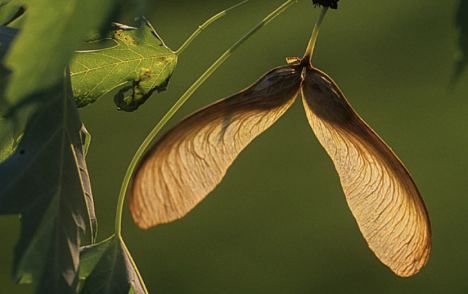
In this lab however, we focused on the component of wind dispersal in samara seeds from Norway maple trees (Acer platanoides). Samaras have adapted the shape of wings to travel through wind. This adaptation allows Samara seeds to travel far in distance in a helicopter motion. This autorotation ability is capable due to the seed’s thick leading edge compared to its wings and dense seed that optimizes the center of the mass for autorotation.
By simply observing the morphology of several A. platanoides seeds we hypothesized a few reasons as to how these seeds can accomplish the greatest distance traveled or in other words the greatest flight time. We suggest that the greater the surface area of the seed the greater the distance traveled just as the lighter the seed in weight the greater the flight time. These key components/ morphologies will distinguish the rate of descent.
Now there are some contradicting elements that will affect the seed’s success. While a lighter seed in weight is seen to be completely beneficial compared to flight time, lighter seeds will also be at a greater risk for mortality. Given the illustration this adaptation demonstrates a trade off between morphology and distance traveled (flight time). This trade off is seen in many species however in this experiment we will discuss the tradeoff relationship of surface area and weight vs flight time in A. platanoides.
Materials:
- A big room
- 15 Samaras Seeds
- Stop Watch
Methods:
In our study of seed dispersal, we focused our attention on samaras, the dried fruits of trees like maple and ashes, characterized by their distinctive winged structure enabling them to travel vast distances. Given their remarkable dispersal capabilities, samaras turned out as the ideal subjects for our study.
To maintain a controlled environment, we conducted our experiment indoors, ensuring precise conditions for our observations. We carefully selected 15 samara seeds, each meticulously labeled for identification. We then measured the weight, length, and width of each seed, and recorded our findings carefully in an Excel spreadsheet.
The next phase of our experiment took flight, quite literally, as we released these labeled samara seeds one by one, positioned precisely at a height of 5.5 meters. As each seed descended, we recorded the flight time (the duration they took to reach the ground). This process was repeated twice, in order to ensure accuracy.
This detailed dataset not only served as a comprehensive record of our experiment but also provided the foundation for in-depth statistical analysis, it helped us understand how samara seeds spread indoors in a controlled environment.
Results:
<Surface Area vs. Flight Time> <Weight vs. Flight Time>
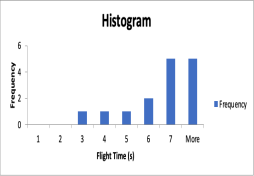
< Flight Time Distribution of Samara Seeds>
By analyzing the collected data, we noticed interesting flight patterns among the 15 samara seeds, even though we were indoors without any wind. Some seeds descended swiftly, almost like a direct drop to the ground, while others lingered in the air for a bit longer.
What caught our attention was that smaller samaras with less surface area seemed to stay up in the air for a longer time, while the larger samaras, with more surface area, descended quickly, almost touching the ground instantly. Also the heavier seeds descended more rapidly than the lighter ones. The graphs clearly illustrate a negative correlation between surface area and flight time, as well as between weight and flight time.
Our analysis revealed that our hypothesis was correct, the lighter the seed the farther the distance. This suggests that during deforestation, seeds like samaras can play a significant positive role in forest recovery.
Discussion:
In this lab we focused on the relationship between the surface area of a samara and the flight time after we threw them off of a balcony. The reason why surface area was significant in this lab was because every plant as well as any other species are unique in size and structure. In “The Terminal Velocity and Dispersal Of Spinning Samaras” by Douglas S. Green, he stated “This plot demonstrated the existence of two distinct groups of samaras, distinguished by their morphology, spinning motion, and rate of descent.” This states that there are a variety of samaras with different features and due to the fact that all samaras are different in shape, size, and weight, we figured that this would have an effect on the flight time. After completing the lab, it was noticed that the surface area of the samara did have an effect on their flight time . This was concluded after we measured the length and width of the samaras to come up with the surface area before throwing them, to find out the flight time. We realized that the samaras that had a smaller surface area took longer to hit the ground while those that had a greater surface area dropped rapidly to the ground.
Before starting the lab, our hypothesis and predictions were that the samara will drop quicker if the surface area was smaller. As we collected data, it allowed us to grasp the reality that our predictions and hypotheses were incorrect. The reason why we were convinced that the results would have this outcome was because we believed that a sample with a greater surface area would take longer to decline if the air was swifting back and forth towards it, leaving the samara struggling to fall. For example, a napkin is very light but has a large surface area. If you throw a napkin off of a balcony, the air would prevent the napkin from falling so fast but that was not the case in this experiment. These trials showed us that when a sample has a greater surface
area they take less time to fall because the sample is bigger/heavier and will plummet down to the ground.
This lab allowed us to see a greater image of seed dispersal. As we are throwing the samaras, it is giving us a visual representation of the dispersal of plant seeds being that these plants are limited in mobility. In “Wind Dispersal of Natural and Biomimetic Maple Samaras” by Gary K. Nave, Jr the writer experimented on dispersal of 3D samaras compared to natural samaras and spoke about samaras and their way of life and evolution. He stated that samaras evolve by spreading their seeds with the air/wind around them. It was determined that the natural samaras dispersed more efficiently than the 3D samaras. This shows that samaras have natural material properties that allow them to perform efficiently when dispersing. This is relevant to our study because it shows that natural dispersion is more accurate than experimental dispersion. Some limitations that we ran into during this experiment were sample size and short observation periods. We realized that every samara was different and some were old with cracks on them. We also observed the samaras falling for a short period of time, in the real world samaras travel far even after hitting the ground due to wind and other factors. This is where biology comes in, these plants wouldn’t be able to evolve if the wind or other organisms like birds don’t help disperse the seeds. The samara experiment was very helpful by giving us an image of the samara lifestyle and reproduction as well as introducing us to factors in their dispersion, like surface area.
Conclusion:
Overall, the samaras seeds are one of those seeds who benefit from the way they are shaped. They rely on nature by the wind to be carried around the land to be grown. These have this magical way of spreading which can help nature all together. Places where seeds have a difficult way of spreading can have its disadvantages. If something happens to that one spot a species of plants grows, the species is dead. Not only that but when deforestation happens plants that can’t spread out so easily the patch will have difficulty growing over time. Having seeds light as wind and dispersing these seeds, nature can regenerate and heal more quickly.
References
Nave Jr, G. K., Hall, N., Somers, K., Davis, B., Gruszewski, H., Powers, C., & Ross, S. D. (2021). Wind dispersal of natural and biomimetic maple samaras. Biomimetics, 6(2), 23. https://doi.org/10.3390/biomimetics6020023
Green, D. S. (1980). The terminal velocity and dispersal of spinning samaras. American Journal of Botany, 67(8), 1218–1224. https://doi.org/10.2307/2442663
Schaeffer, B. M., Truman, S. S., Truscott, T. T., & Dickerson, A. K. (2024). Maple samara flight is robust to morphological perturbation and united by a classic drag model. Communications Biology, 7, Article 248.

